|
|
No
Taper Allows More Clearance for Picking
"High-Low" Codes |
|
When
you look at the illustrations on the previous page,
you get a better understanding of why some locks are
more difficult to pick than others. Sometimes the pick
blade itself is the enemy. If the blade has a taper
on the top surface, (as most all steel picking
blades do), then you may be defeated before you start
picking because if that taper makes contact with a
bottom pin that is already at the shear-line of the
lock, it will force that pin upward to re-block the
shear-line again. You have no choice! If
you move that tapered blade against any bottom pin it
will force that pin to move upward. When you initially
insert a tapered blade into the key-way of a lock, the
"tip" moves the 1st pin upward. Perhaps the
"tip" even positions the pin at the
shear-line. But what happens as you continue moving
the tapered blade inward? That taper
now makes contact with the 1st pin and it forces that
pin upward, to re-block the shear-line. These "newly
developed" all metal diamond
"tips" come in five (5) different heights.
The round needle shaft allows more clearance
when picking a lock because there is no taper on the
top surface of the needle and it is thinner, but
stronger than a standard flat picking blade. Any pin
at the shear-line, will stay at the shear-line. There’s
no taper to push it back up to re-block the
shear-line. The needle shaft is "flat"
on top and bottom, for its entire length. Tip
heights are normally in fifteen thousandths
increments (.015), which allows "you" to
have a greater selection when picking a lock.
FORTY PICKING BLADES
TO CHOOSE FROM.
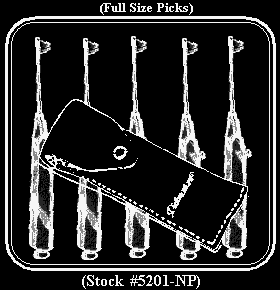
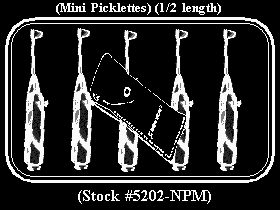
Five (same diameter) picking blades per set. Five (5)
different diamond tip heights per set. Sets of five
(5), ten (10), twenty (20), & forty (40) are
available in soft, genuine leather carrying cases.
|
|
"STOP
Picking
Locks with Tapered Steel Blades"
(Now there is
a Better Way) |
 |
|
"An
Impossible Task" |
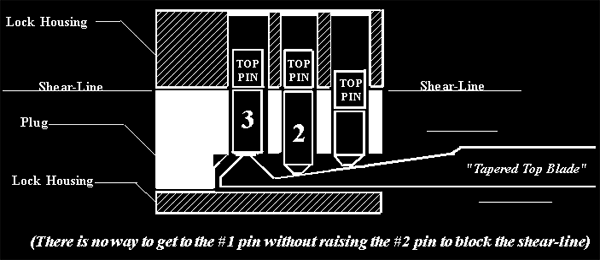
| The
illustration above shows the #2 and #3
pin picked to the shear-line while the #1 top
pin is blocking the shear-line. The lock will
not open. You must pull the "Tapered"
Pick Blade outward to move the #1 pin
up to the shear-line, but when you do this,
the #2 pin will be forced upward
by the back angle on the pick and the #1 pin
will drop because of the taper on the top of
the blade. The #2 pin will now block the
shear-line. Continue pulling outward and the
#2 pin will seize in place and the #1
pin will continue to drop. If you release
turning pressure on the plug, the #2 pin may
drop to the shear-line, but the #3 pin may
also drop before you can get to the #1 pin to
raise it to the shear-line. This is all done
blindly! You can't see inside the lock! Seems
like a difficult or impossible task to me!
What do you think? |
|
|
|
There is no way
to get to the #1 pin without raising the #2 pin upward
to block the shear-line even more than it is. The
taper on top of the pick blade is not helping matters.
If it were a "Round,
Needle Blade"
with a "Flat Top", the
#1 pin AND the #2 pin would already be at the
shear-line and the lock would open.
|
|
"Try
This One"
|
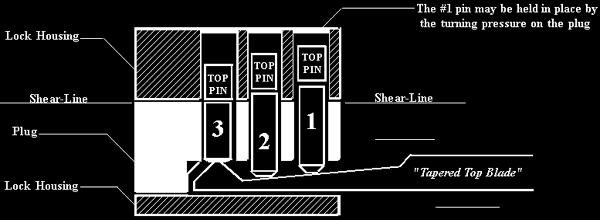
| The
illustration above shows the #3 pin located
at the shear-line. The #2 pin is just slightly
blocking the shear-line. What will happen if you
move the pick blade rearward, to get to the #1
pin, to place it at the shear-line? Of course. The
#2 pin will be raised upward even further by the
angle on the back side of the pick blade and it
will then be fully blocking the shear-line.
While you are raising the #2 pin upward the taper
on the top of the pick blade is allowing the #1
pin to drop, but now you have another problem. The
#2 pin is blocking the shear-line and the #3 pin
has no support, so it may drop to re-block the
shear-line. Remember, this is all being done
blindly, as you can't see inside the lock. Another
difficult task! The angle (taper) on the top
side of the pick blade is a definite wrong
design, as is with most steel blades.
Check your inventory. Most picks on the market are
designed that way to give the blade strength, but
at the same time it defeats what you are trying to
do. Pick the lock. |
|
|
Now
take a look at all the clearance on the bottom of the
"Round"
Pick Blade
|
|
Using
The Small Size Diamond Tip |
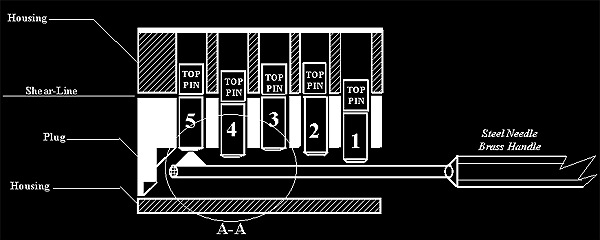
| Notice
the amount of space between the bottom of the
round picking blade and the top shelf of the
key-way. It allows you to drop the entire
picking blade down if you need to clear a low
hanging bottom pin, that's already located at
the shear-line. The strength of the blade is in
the "diameter", not in the
width, as in a standard, flat steel picking
blade. |
|
 |
|
Using The "Large" Size Diamond Tip
|
|
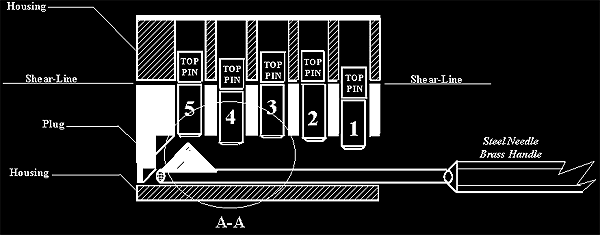
You
can tell, this lock is going to get picked open
real fast, just by looking at it.
There
are forty (40) different picks to choose from.
Eight (8) sets of five. Each set has a different
diameter & each set has diamond shapes with
five (5) different heights.
Standard
Size or Mini. Your Choice. |
|
 |
| |
|
|