|

|
Click Here to navigate through our site:
|
|
|
PART
NUMBER |
Tension Wrenches |
PRICE |
|||||||
|
Want to Pick a Lock Faster? Every Locksmith knows that Picking a Lock is an "Art" and any Art requires lot’s of practice. They also know that "Tension Control" is the Most Important Factor of that "Art". We have now conquered the "Art" of Tension Control. No more, "Lot’s of Practice" required. If you are having trouble picking locks open as a beginner, a student or a long time professional lock picker, this new Tension Control System is a must for your tool box. It allows you to pick the lock with one hand while the weights control the tension. FASTER OPENINGS GUARANTEED!
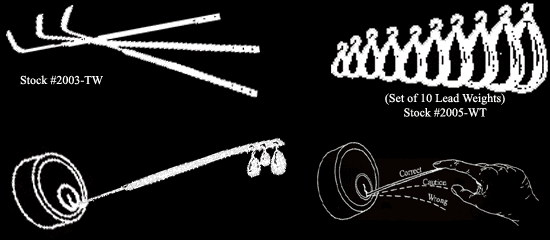
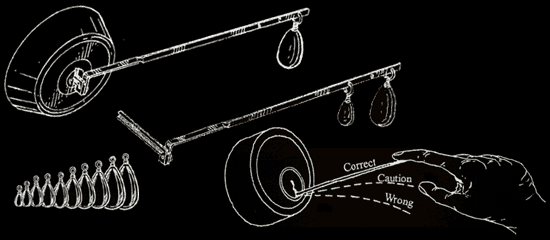
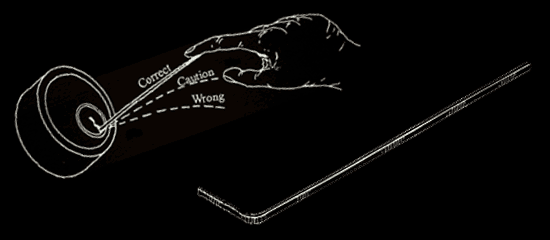
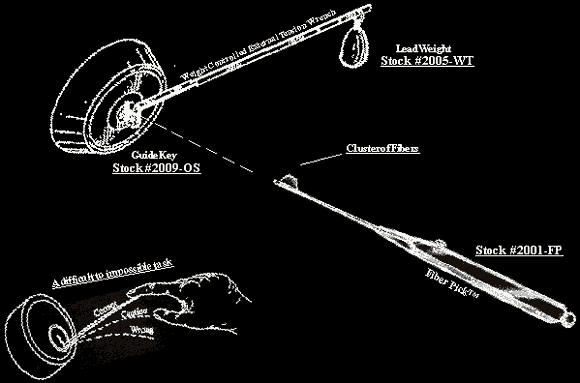
TOTAL TENSION CONTROL WITHOUT HUMAN "FINGER" ERROR Look at the illustration above that shows a finger holding the tension on the plug of a lock. It shows that there is a correct tension to apply, but it also shows a caution area and a wrong amount of tension to apply. By using the Weighted Tension Wrench shown above, it illiminates all of the errors in tension, that you may apply to the lock while trying to pick it open. This System is not only a tremendous help to you while picking the lock, but it also teaches you exactly how much tension should be applied. Observe the amount of turning pressure the weight is creating on the plug. INSTRUCTIONS Insert a Tension
Wrench into the key-way of the lock you are going to pick.
Select a weight and hook it into one of the three holes located
along the extended arm of the tension wrench. Pick the lock as
you normally would by sliding the picking blade in and out of
the key-way. The weight hanging on the tension wrench will
provide the correct turning pressure on the plug of the lock to
pick it open. When the lock is picked, the weight will drop
because of gravity and the plug will turn the lock open.
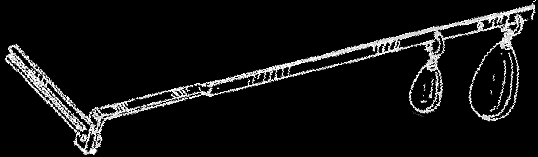
Introducing the New and Unique Lock Picking System "A Little About Tension Control" As you can see by the illustrations above, there is an external tension wrench attached to a precision machined key blank. The key performs a very important function, because it blocks the entire bottom half of the key-way and leaves the entire top half of the key-way open, during the picking process. The blade of the key blank is inserted to the "full length" of the key-way which results in a more controlled turning pressure on the "entire length" of the plug, unlike a standard tension wrench which is only about 1/2" in length and only makes contact with a small portion of the front end of the lock plug, resulting in a "twisting" action on the plug, at the front end. The bottom half of the key blank, when inserted into the plug will guide and support the bottom of the pick blade thru-out the entire length of the key-way, front to bottom. The top half of the key way is open, and it guides and supports both sides and the top of the picking blade. Trying to control the tension on the plug of a lock with your index finger while the picking process is going on is difficult at best, as the illustration shows above. Too much tension on the plug will "bind" the pins in the lock to a point where they can’t be moved. Too little tension on the plug will result in the springs in the lock over-powering the pins, causing them to be forced back to blocking the shear line, even if the shear line had already been established. Somewhere "in between" all that is the correct tension to be applied to the plug. How do you tell a student or beginning lock picker just where that "in between" is? The illustration above shows weights hanging from the extended arm of a new External Tension Wrench. There are various weights available and three locations to hang them from. That means that you have more than a thousand (1000) different combinations you can try to create a "perfect" tension with positive control on the extended handle and the plug of that lock. If you’ve already got experience in picking locks, you’ll already know what weights to use. Whether you are a student or a beginner or an experienced lock picker, this system will teach you tension control. Picking with one hand is now possible using these weights. Introducing the New and Unique, Weighted Tension Wrench
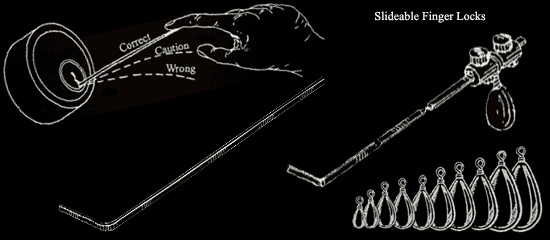
Ten (10) different Weights and 2 Slideable Finger Locks (Weights and Slideable Finger Locks are sold separately and can be used on "YOUR" tension wrenches) Remember, tension control is the single most important factor in picking a lock. It makes absolute sense, to want to use the best available tension control while picking. Look at the illustration above that shows a human hand attempting to hold a constant tension on the plug of a lock. As you can see, it is an extremely difficult task. Tension Control is probably the biggest reason "WHY" lock picking is so difficult. One finger can’t hold a proper and constant turning pressure on the plug of a lock while trying to use a Steel Pick Blade to lift the pins to a shear-line. Steel Picks are non forgiving. They will overpower an improper tension on a lock plug every time and push a pin, that is already located at the shear-line, back upwards, to re-block the shear-line. On the other hand, if there isn’t enough tension on the plug, the springs in the lock will over power the light tension on the pins and force them back downward to re-block the shear line. The various weights shown above can be located along the extended handle of "your" tension wrenches. They can then be locked in place by the two "Slideable Finger Locks" shown in the illustration above. Now you can control the tension on the plug while you concentrate on picking the lock. "TENSION WRENCHES" Tension wrenches do not
fit precisely into the key-way of any lock, like a key does.
They just don’t. A key is manufactured as a very precise
instrument that fits exactly into the key-way, it
was intended for. Tension wrenches are "sloppy"
at best and they allow the blade of a pick to slide down on any
angle that might be machined into the key-way. That means that
when the tip of the pick blade makes contact with the pin in the
lock, it is more than likely, at an angle and that right there,
causes you to loose control of the picking process. Also, the twisting
action that a tension wrench creates, is at the
"front" of the lock. It is not a
"constant" turning pressure thru-out the entire length
of the plug. More than likely, the first and second pin, going
in, has more tension on them, than all the rest. Twisting
action on the plug gives off false information and is bad for
picking. "The
Tension Wrench"
I don’t
mean this to be offensive because I’ve used this
tool "myself" for over 30 years, but... I say this
because the tension wrench shown above doesn’t fit. It doesn’t
fit any lock. Not a precision fit, that is. When
Linus Yale invented the pin tumbler lock over 150 years ago, it
didn’t take long before someone figured out that if you put a "bent
piece of metal" into the key-way of a lock, you could
apply turning pressure on the plug. Well, that theory has been
around ever since. No one has changed it. No one has figured out
a "better way". Not until now, that is. Stop
using that out-dated method. (Now there’s a better Way) INTRODUCING THE ALL "NEW" GUIDE-KEY™ , WEIGHTED TENSION WRENCHES™
*For added tension control & better picking results, use the lead weights for one hand picking. Introducing the New and Unique, Patented Fiber Pick™
|
|||||||||
Copyright 2001. All rights reserved.